🚗 Vehicle Combat
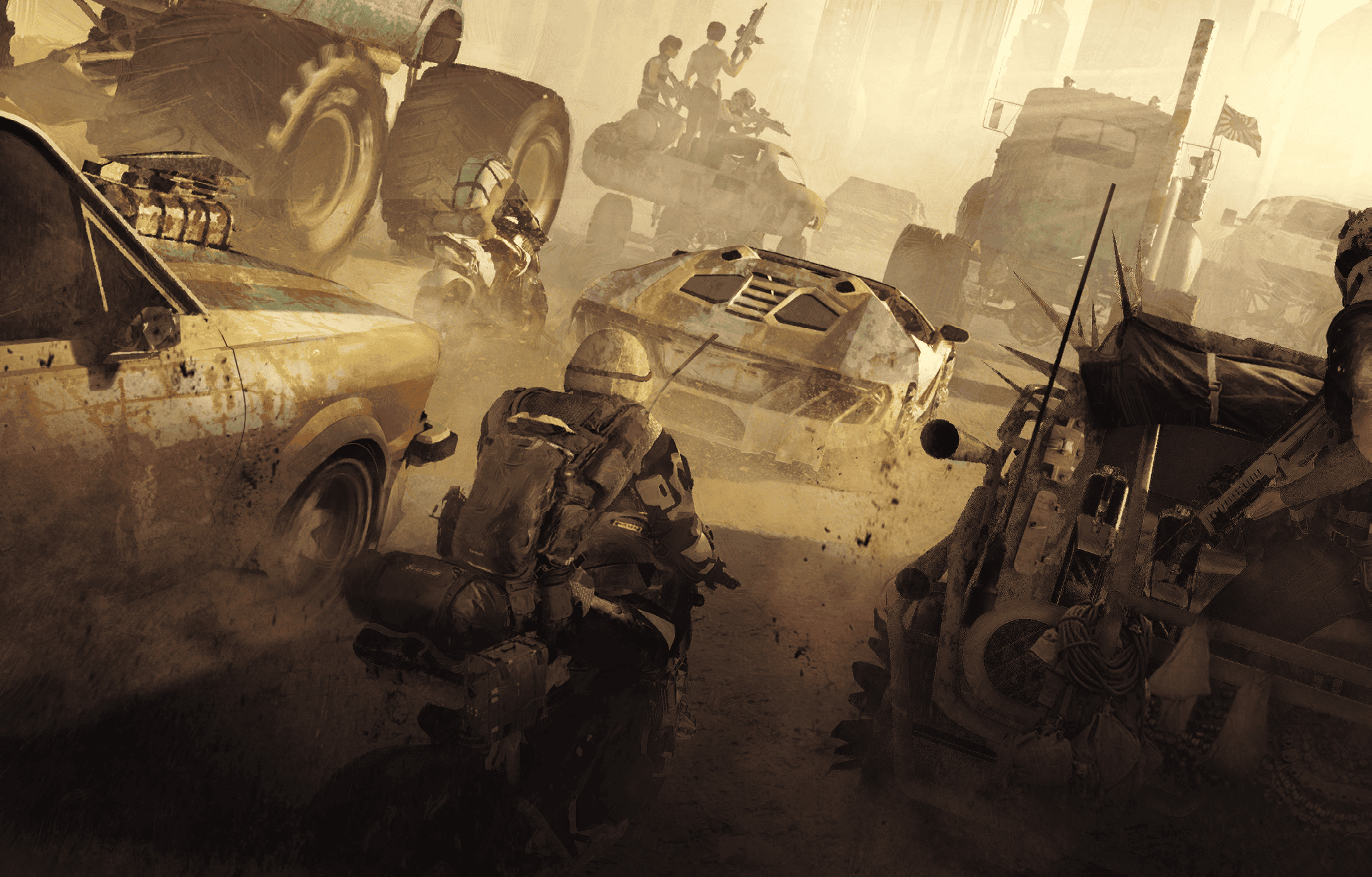
“In Night City, the car chase is an art form. The artistry? Surviving it.”
This chapter covers everything you need to run exciting vehicle combat, chases, and highway firefights.
🌍 Lore: Vehicles in the Time of the Red
The Dark Future hasn’t yielded any staggering new transportation breakthroughs. Years of economic strife and the 4th Corporate War have left a patchwork of badly up-kept roads, abandoned airports, and trains plagued by gangs. Most vehicles run on CHOOH² — a synthetic alcohol fuel produced by Biotechnica — since petroleum is nearly gone.
Private vehicles are a luxury. At 20,000–100,000eb, even a basic bike costs more than most Night Citizens earn in years. Corporate execs drive armored groundcars with escorts. Nomads run heavily armed convoys of 100+ vehicles — Kombis, escort cycles, armored trucks — and control most long-distance transport, including Aerozep cargo blimps. For everyone else, there’s the unreliable NCTC bus system or your own two feet.
Air travel is rarer still. Commercial airlines are effectively dead. If you need to fly, you hire a Nomad Aerozep or pay a “deltajock” — ex-military pilots running suborbital scram-jets, no questions asked. AVs are exclusively corporate or military hardware; Trauma Team runs a fleet of AV-4s, and that’s about the only time civilians see one up close.
🚙 Vehicles Overview
Land Vehicles
| Vehicle | Description | SDP | Seats | Combat MOVE | Cost |
|---|---|---|---|---|---|
| Roadbike | Common CHOOH² powered bike | 35 | 2 | 20 | 20,000eb |
| Superbike | Exotic high-speed streetbike | 35 | 2 | 60 | 100,000eb |
| Compact Groundcar | Common CHOOH² powered car | 50 | 4 | 20 | 30,000eb |
| High Performance Groundcar | CHOOH² powered sportscar | 50 | 2 | 40 | 50,000eb |
| Super Groundcar | Exotic extreme-speed sportscar | 50 | 2 | 60 | 100,000eb |
Sea Vehicles
| Vehicle | Description | SDP | Seats | Combat MOVE | Cost |
|---|---|---|---|---|---|
| Jetski | Personal watercraft | 35 | 2 | 20 | 20,000eb |
| Speedboat | CHOOH² powered speedboat | 50 | 4 | 20 | 30,000eb |
| Cabin Cruiser | Luxury powerboat with rooms | 60 | 2/room | 10 | 30,000eb/room (min 2) |
| Yacht | Luxury pleasurecraft with rooms | 100 | 4/room | 10 | 50,000eb/room (min 4) |
Air Vehicles
| Vehicle | Description | SDP | Seats | Combat MOVE | Cost |
|---|---|---|---|---|---|
| Gyrocopter | Tiny rotorcraft | 35 | 2 | 20 | 20,000eb |
| Helicopter | Full featured helicopter | 60 | 4 | 40 | 40,000eb |
| AV-4 | Urban assault aerodyne | 100 | 6 | 40 | 50,000eb |
| AV-9 | Extreme-speed aerodyne | 60 | 2 | 60 | 100,000eb |
| Aerozep | Modern cargo blimp with rooms | 100 | 2/room | 20 | 30,000eb/room (min 2) |
📋 Core Vehicle Rules
Structural Damage Points (SDP)
- All vehicles have SDP instead of HP
- As long as a vehicle has at least 1 SDP, it can still move
- At 0 SDP: Vehicle is Destroyed
- No longer provides cover
- Cannot move without repairs
- Repair requires appropriate Vehicle Tech Skill
Targeting Vehicles
- Vehicles cannot dodge like humans
- Shooting a vehicle still uses the Range Table from Combat Rules
- While inside a vehicle, you can still dodge attacks targeted at you (not the vehicle)
Weak Points
Called Shots on Vehicles
To hit a vehicle’s weak point (engine, tires, driver):
- Use Aimed Shot (entire Action)
- Take -8 penalty to your Check
- If successful: Multiply damage that gets through by 2
CRB Note
The book references “damage that gets through the vehicle’s SP” but the vehicle tables have no SP stat — only SDP. In practice, vehicles have no armor SP unless the GM adds custom plating, so ×2 typically applies to the full damage roll.
Getting In/Out
| Action | Cost |
|---|---|
| Getting INTO a vehicle | 1 Action |
| Getting OUT OF a vehicle | Part of Movement (free) |
Starting/Stopping
| Action | Cost |
|---|---|
| Starting a vehicle | 1 Action |
| Stopping a vehicle | 1 Action |
When a Vehicle Starts
- Driver moves to top of Initiative queue
- Vehicle’s MOVE becomes driver’s MOVE
- Driver cannot use Run Action while driving
🚗 Basic Driving
Automatic Driving
If your REF + Control Skill is greater than 9, basic driving requires no check.
Struggling Drivers
If your REF + Control Skill is 9 or less:
- Use your Action every Turn to attempt a DV 10 Check
- Roll:
REF + Control Skill + 1d10 - Failure: Lose Control of the Vehicle
⚡ Maneuvers
When the GM calls for a maneuver, it requires both your Action AND your Move Action.
Maneuver DVs
| Maneuver | DV | Description |
|---|---|---|
| Swerve | 13 | Quick lane change to avoid obstacle |
| Sharp Turn | 13 | 90° turn at speed |
| Emergency Stop | 13 | Full stop without losing control |
| Bootleg Turn | 17 | 180° turn, continue in opposite direction |
| Jump | 17 | Launch vehicle off ramp or obstacle |
| Landing (Air) | 13 | Safe touchdown |
| Aerobatic Maneuver (Air) | 17 | Loop, roll, or dive |
Failing a Maneuver
Any failed maneuver causes you to immediately Lose Control.
💥 Losing Control
When you lose control of a vehicle:
- You cannot take other Actions until control is regained
- Vehicle moves in an unpredictable direction (GM decides)
- May collide with obstacles or other vehicles (see Ramming)
Regaining Control
The CRB does not specify an explicit mechanic for regaining control. The GM determines when and how control can be recovered. A common homebrew ruling is:
REF + Control Skill + 1d10 vs. DV 13on your next Turn.
🚗💨 Ramming
When a vehicle collides with something that has HP (person, cover, another vehicle):
Damage
Both the vehicle AND the target take 6d6 damage
Whiplash
Everyone involved (drivers, passengers, pedestrians) suffers the Whiplash Critical Injury:
- -2 to all Actions for 1 hour unless treated
Breaking Through
- If the target’s HP reaches 0 from ramming damage, your movement can continue
- Otherwise, your vehicle must stop
Dodging a Ramming Vehicle
Dodging on Foot
Check: DEX + Evasion + 1d10 vs. DV 13
- Success: Dive out of the way, no damage
- Failure: Take 6d6 damage, Whiplash injury
🔫 Fighting From Vehicles
Driver Actions (RAW Clarification)
What the Rules ACTUALLY Say
The Core Book states:
- Basic driving (REF + Skill > 9) requires no Action
- Maneuvers (sharp turns, jumps, etc.) require your Action AND Move Action
This means: If you’re not performing a maneuver, your Action is free!
| Situation | Can Driver Attack? |
|---|---|
| Cruising straight, REF + Skill > 9 | ✅ Yes (basic driving is automatic) |
| Performing a Maneuver | ❌ No (maneuver takes Action + Move) |
| REF + Skill ≤ 9 | ❌ No (must use Action to maintain control) |
| Stopped vehicle | ✅ Yes (not driving at all) |
Homebrew: Drive-By Shooting
For vehicle-to-vehicle or drive-by combat where the driver shoots:
- One-handed weapon only (pistol, SMG)
- -2 penalty to attack (driving distraction)
- No Aimed Shots while driving
- If attacked, must pass DV 13 Drive check or Lose Control
Passenger Actions
Passengers can attack normally from a vehicle:
| Factor | Effect |
|---|---|
| Ranged attacks | Use standard Range DVs |
| Melee attacks | Only if vehicles are adjacent or you’re leaning out a window |
| Two-handed weapons | Only if not holding on (GM discretion) |
Homebrew: Passenger Penalty
Some tables apply a -2 to attack rolls for shooting from a moving vehicle. The CRB does not specify a penalty for passengers — this is a common homebrew.
Shooting AT Vehicles
| Target | Notes |
|---|---|
| The Vehicle | Standard attack vs. Range DV, damage reduces SDP |
| A Person Inside | Aimed Shot (-8) to target a specific occupant, or shoot through vehicle |
| Tires/Engine | Aimed Shot (-8), ×2 damage, may cause Loss of Control |
Targeting Occupants
The CRB doesn’t explicitly cover targeting people inside vehicles. The Aimed Shot (-8) approach is a widely-used GM ruling based on the Weak Points mechanic.
🏎️ Example: Vehicle Combat Turn
Vehicle Combat in Action
Situation: Marcus (Solo) is driving a Compact Groundcar (MOVE 20, 50 SDP). Two Maelstrom gangers on Roadbikes (MOVE 20, 35 SDP each) are chasing him. Kira (Fixer) is in the passenger seat.
Round 1:
Initiative:
- Marcus rolled 18 (REF 8 + 1d10)
- Kira rolled 14
- Ganger A rolled 12
- Ganger B rolled 10
Marcus’s Turn:
- Marcus’s REF 8 + Drive 4 = 12 > 9, so basic driving is automatic
- He’s just cruising (no maneuvers), so his Action is free
- Marcus draws his pistol and fires at Ganger A (about 10m away = DV 15)
- Attack: REF 8 + Handgun 6 + 1d10(7) = 21 vs DV 15 → Hit!
- Damage: 3d6 = 11. Ganger A has SP 7 body armor → 11 - 7 = 4 damage
- Marcus’s car continues moving forward at MOVE 20
Kira’s Turn:
- As passenger, Kira can attack freely
- She fires at Ganger B (also about 10m) with her Heavy Pistol
- Attack: REF 6 + Handgun 4 + 1d10(8) = 18 vs DV 15 → Hit!
- Damage: 3d6 = 14. Ganger B has SP 7 → 14 - 7 = 7 damage
Ganger A’s Turn:
- Tries to pull alongside Marcus’s car and shoot into the cabin
- Ganger has REF 6 + Drive 3 = 9, so must spend Action to maintain control
- ❌ Can’t attack this turn! (REF + Skill = 9, needs Action to drive)
- Pulls up alongside the car
Ganger B’s Turn:
- REF 7 + Drive 4 = 11 > 9, so can attack!
- Fires SMG at Marcus through the windshield
- Needs Aimed Shot (-8) to target Marcus specifically, or just damages the car
- Attacks the car: REF 7 + Handgun 4 + 1d10(6) = 17 vs DV 15 → Hit!
- Damage: 2d6 = 9 → Car takes 9 SDP damage (down to 41 SDP)
End of Round 1:
- Marcus: Full HP, car at 41 SDP
- Kira: Full HP
- Ganger A: Took 4 damage
- Ganger B: Took 7 damage
- Positions: Gangers are alongside Marcus’s car
Note: This example uses RAW (no vehicle shooting penalties). If your table uses the homebrew -2 penalty, subtract 2 from each attack roll above.
🏎️ Vehicle Chases
These rules work alongside the standard vehicle combat rules above, providing a framework for quick, tense chase sequences where driving ability counts as much as vehicle speed.
Setting Up the Chase
The GM sets up a Chase Grid — an abstract track where each square represents one band on the Range Table.
| # of Squares | Range Band |
|---|---|
| 1 square | 0–6 m/yds |
| 2 squares | 7–12 m/yds |
| 3 squares | 13–25 m/yds |
| 4 squares | 26–50 m/yds |
| 5 squares | 51–100 m/yds |
| 6 squares | 101–200 m/yds |
| 7 squares | 201–400 m/yds |
| 8 squares | 401–800 m/yds |
Example: Chase Grid Setup
The Crew’s car chases a thief’s truck. The thief has a 3-square head start:
[Crew Car] --- [ ] --- [ ] --- [Thief's Truck]The Crew is 13–25 m/yds behind.
Initiative
Operators (drivers) roll Initiative normally — they do not automatically jump to the top of the queue like when starting a vehicle.
Chase Rounds
Each participant gets one Move Action and one standard Action, just like normal combat.
Move Actions
- Change position inside the vehicle (e.g., jump into turret seat)
- Climb onto the roof or vice versa
- Leap from vehicle to a location within range based on MOVE stat — even another vehicle
- Can be held to sync with the operator’s maneuver (e.g., wait for a Pull-In Close)
When leaping, use the far end of the current range band unless the operator performed a Pull-In Close maneuver.
Standard Actions
- Any Action you could perform in normal combat, accounting for circumstances
- Range to other vehicles = position on the Chase Grid
- Melee attacks require vehicles to be adjacent AND a Pull-In Close maneuver first
Positioning (End of Round)
At the end of each Chase Round, every operator makes a Positioning Check — a vehicle control Skill Check. This is not an Action.
Positioning Check DVs:
| Combat Speed | DV |
|---|---|
| 60 MOVE | 13 |
| 40 MOVE | 15 |
| 20 MOVE | 17 |
| 15 MOVE | 21 |
| 10 MOVE | 24 |
| 8 MOVE | 29 |
- Success: Move forward 1 square on the Chase Grid
- Fail: Stay where you are
- Maintain speed: Choose not to move (no check needed)
- Slow down: Move backward 1 square (no check needed)
Damaged Vehicles
A vehicle below ½ maximum SDP makes the check as if one Combat Speed category lower (e.g., 10 MOVE instead of 15 MOVE). If this would drop below 8 MOVE, the vehicle spins out and crashes (CP:R p. 192).
Operator Restrictions
- Operators do not use Move Action to move the vehicle — that’s the Positioning Check
- If REF + Control Skill + bonuses < 9, the operator cannot take a Standard Action — all energy goes to maintaining control
- If the operator leaves the control seat, someone else should slip into it immediately
Chase Maneuvers
The GM can place obstacles, hazards, or sharp turns in the path during a Chase Round. When this occurs, all operators must use their Standard Action for a Maneuver Check (standard rules, CP:R p. 192). Failure = fall back 1 square or spin out (GM decides by severity).
In addition to the standard maneuvers, operators can perform the following during a chase:
| Maneuver | DV | Requirements | Effect |
|---|---|---|---|
| NOS | 13 | Vehicle has NOS | Activate as Standard Action. Automatically move 1 square forward. Check determines if you maintain control. |
| PIT Maneuver | 15 | Adjacent to target | Tap the target vehicle. Target’s next Positioning Check treats speed as one category lower. If that drops below 8 MOVE → spin out and crash. |
| Pull-Ahead | 17 | Adjacent to target | On success, move 1 square ahead of target. On failure, spin out or hit obstacle (CP:R p. 192). |
| Pull-In Close | 13 | — | Push to the lower edge of current range band until end of Round. Enables leaps between vehicles and melee attacks. |
| Ramming | 17 | — | Focused attempt to crash into target while maintaining control. Otherwise follows standard ramming rules (CP:R p. 192). |
Passenger Actions
Passengers take any normal combat Action from inside (or on top of) a moving vehicle. They can also provide Complementary Skill Check bonuses (CP:R p. 130):
- Local Expert — Shout directions → bonus to operator’s next Positioning Check
- Perception — Spot obstacles → bonus to operator’s next Maneuver Check
- Tactics — Direct ally fire → bonus to an ally’s Attack Check
- Creative options — Paintball on windshield (impose penalty), throw obstacles (force emergency Maneuver), etc.
Ending the Chase
A chase ends when:
- A vehicle can’t continue (destroyed, stopped, occupants surrender)
- Vehicles move more than 8 squares apart on the Chase Grid — the lead vehicle vanishes into the urban jungle
🏁 Multi-Vehicle Chases
Homebrew Rule
These rules extend the CRB Chase Grid for encounters with 3+ vehicles — convoy defense, gang ambushes, highway battles. All base chase rules above still apply.
Anchor Vehicle
Designate one vehicle as the anchor at square 0. The anchor:
- Makes no positioning checks — it stays at square 0 every round
- Sets the chase’s baseline speed (its MOVE)
- Can still perform maneuvers (swerve, emergency stop) if obstacles appear
All other vehicles’ positions are relative to the anchor. Higher squares = further behind (pursuers closing in).
When to use: Convoy defense (anchor = cargo truck), escort missions, or any chase where one vehicle sets the pace and doesn’t try to race.
Anchor Maneuver Failure
If the anchor’s driver fails a maneuver check, all other vehicles effectively gain 1 square of closure (everything shifts forward). The anchor’s driver must regain control before the chase continues normally.
Group Positioning
Identical or similarly-statted vehicles (e.g. 4 gang bikes, all MOVE 20) can be grouped:
- Roll one positioning check for the entire group
- The group advances, holds, or stays together as a unit
- Individual vehicles split off only when destroyed, disabled, or ordered to break formation
This reduces a 6-bike swarm from 6 positioning rolls to 1.
Between-Category Speeds
If a vehicle’s MOVE doesn’t match a row on the Positioning DV table exactly, use the lower MOVE row (harder DV):
| Actual MOVE | Use Row | DV |
|---|---|---|
| 25–39 | MOVE 20 | 17 |
| 16–19 | MOVE 15 | 21 |
| 11–14 | MOVE 10 | 24 |
| 9 | MOVE 8 | 29 |
Dominant Speed
If a vehicle’s Combat Speed is 2 or more rows higher on the Positioning DV table than the slowest vehicle in the chase, its operator auto-succeeds all positioning checks. They freely choose each round: advance 1 square, hold position, or fall back 1 square.
Chase maneuvers (PIT, Pull-Ahead, Ramming, etc.) still require a check — only positioning is automatic.
Example: Dominant Speed
A chase has a MOVE 15 cargo truck (anchor), MOVE 20 escort cars, and a MOVE 40 interceptor bike.
The Positioning DV table rows: MOVE 60 (row 1) → MOVE 40 (row 2) → MOVE 20 (row 3) → MOVE 15 (row 4) → MOVE 10 (row 5) → MOVE 8 (row 6).
- Slowest vehicle: MOVE 15 (row 4). Two rows higher = row 2 = MOVE 40+.
- The MOVE 40 bike auto-succeeds positioning. Its rider closes, holds, or pulls back at will.
- The MOVE 20 escort cars still roll (DV 17) — only 1 row above the anchor.
Same-Square Rules
Multiple vehicles can occupy the same square. Vehicles in the same square are:
- Adjacent — can ram, board (with Pull-In Close), or engage in melee
- At 0–6m range for shooting (use the 1-square row in the Range DV table below)
Chase Grid — Range DV Reference
Use this table to look up shooting DVs directly from the chase grid, without flipping to the Ranged Combat page. Count the squares between the shooter’s vehicle and the target. Bold = that weapon’s sweet spot (lowest DV).
| Squares Apart | Range | Pistol | SMG | Shotgun | AR | Sniper | Bow |
|---|---|---|---|---|---|---|---|
| 1 | 0–6m | 13 | 15 | 13 | 17 | 30 | 15 |
| 2 | 7–12m | 15 | 13 | 15 | 16 | 25 | 13 |
| 3 | 13–25m | 20 | 15 | 20 | 15 | 25 | 15 |
| 4 | 26–50m | 25 | 20 | 25 | 13 | 20 | 17 |
| 5 | 51–100m | 30 | 25 | 30 | 15 | 15 | 20 |
| 6 | 101–200m | 30 | 25 | 35 | 20 | 16 | 22 |
| 7 | 201–400m | — | 30 | — | 25 | 17 | — |
| 8 | 401–800m | — | — | — | 30 | 20 | — |
Vehicles in the same square use the 1-square row (0–6m). A — means the weapon cannot reach that range.
Tactical Takeaway
- Pistols and Shotguns want point-blank (1 sq). Close fast or lose effectiveness.
- SMGs peak at 2 squares (7–12m) — ideal for flanking vehicles.
- Assault Rifles peak at 4 squares (26–50m) — the dominant chase weapon.
- Snipers peak at 5 squares (51–100m) — pick off targets before they close.
- Bows/Crossbows peak at 2 squares (7–12m) — same bracket as SMGs.
For Grenade Launchers, Rocket Launchers, and exotic weapons, see 📏 Range DVs by Weapon Type.
GM Workflow — Running Multi-Vehicle Chases
Efficient Round Structure
- Start of round: Roll positioning for each NPC vehicle or group (bikes together, boss vehicles solo). Move tokens on the grid.
- Announce positions: “Bikes close to square 3 — that’s 26-50m. Harvester holds at square 5.”
- Player turns: PC operators roll positioning during their turn (end of round per RAW, but resolving during their turn is fine for flow). Passengers act normally.
- NPC actions: Resolve NPC attacks, maneuvers, and boarding attempts.
- Check for chase end: Any vehicle at 8+ squares apart is gone. Any vehicle at 0 SDP is destroyed.
Pacing target: With group positioning and the range DV table, even a 10-vehicle chase should resolve in under 5 minutes per round.
❓ Quick Answer Reference
Can the driver shoot?
Yes, in some situations!
- If your REF + Drive Skill > 9 AND you’re not performing a maneuver, basic driving is automatic and your Action is free.
- If you ARE performing a maneuver (sharp turn, jump, etc.), no — the maneuver takes your Action.
- If your REF + Skill ≤ 9, no — you need your Action to maintain control.
- Common homebrew: -2 to attacks while driving, one-handed weapons only.
Can passengers attack?
Yes! Passengers can attack normally using standard Range DVs. The CRB does not specify a penalty, though some tables use a homebrew -2.
What happens if my vehicle hits 0 SDP?
Vehicle is Destroyed. It stops, can’t be driven, and no longer provides cover. Repair requires Tech skill and time.
Can I ram people on foot?
Yes! They can dodge (DV 13). If hit, they take 6d6 damage and Whiplash Critical Injury.
Does armor help against ramming?
Yes. The 6d6 ram damage is reduced by the victim’s body armor SP as normal.
Can I shoot out tires?
Yes! Aimed Shot (-8) to tires. Success may cause the driver to Lose Control (GM discretion).
How do I escape a chase?
Get more than 8 squares ahead on the Chase Grid. Once you’re that far, you vanish into Night City’s urban maze. Alternatively, if the other vehicle can’t continue (destroyed, stopped, surrendered), the chase ends.
When do I jump to top of Initiative?
When you Start a vehicle. You immediately go first.
🔗 Related Topics
- Combat — All combat rules
- Ranged Combat — Shooting from vehicles
- Weapons and Gear — Ammo types, weapon quality
- Damage and Wounds — Taking damage
- Armor and Cover — Vehicles as cover
(Source: Cyberpunk RED Core Rulebook pp. 189–192; Tales of the RED: Hope Reborn pp. 180–182)