🔍 Investigation
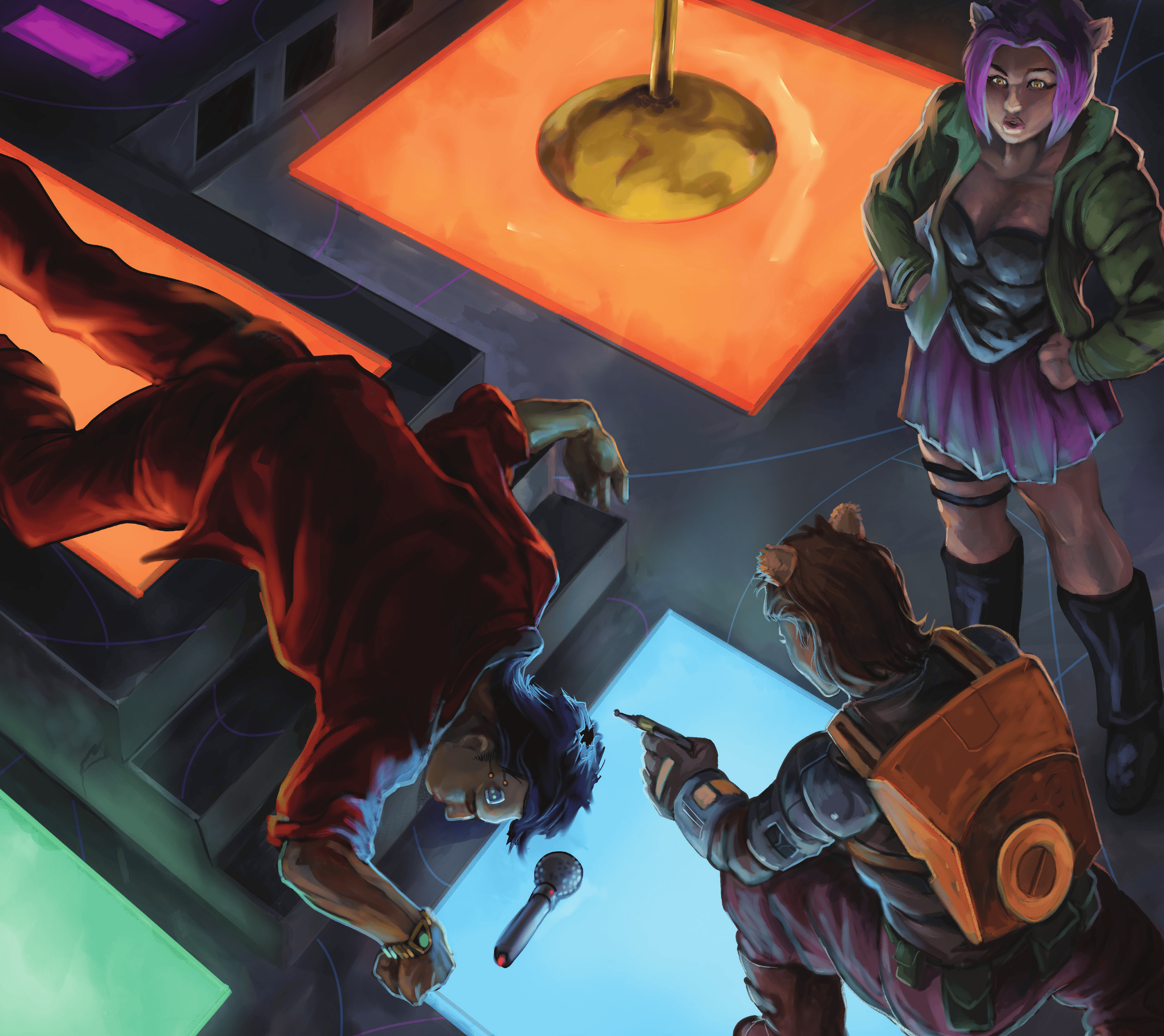
“Not every case ends with a firefight. Some end with a whisper — and a name you wished you’d never learned.”
Night City is built on secrets. Stolen tech, disappeared people, covered-up murders — when the bullets stop flying, somebody still needs to figure out what happened. The Investigation System gives Edgerunners the tools to crack mysteries, gather Clues, and follow trails of evidence through Night City’s web of lies.
This system doesn’t replace roleplay — it supports it. Think of it as a mechanical skeleton for your detective work, keeping the mystery on track while you play out the interrogations, stake-outs, and crime scenes.
⚡ Quick Reference
Investigation At A Glance
Concept Summary Focus Derived stat = 10 + 5 × [(INT + WILL) / 2, round up]. Your mental stamina for investigating.Mystery Has a Goal (what you’re solving) and Complexity (HP to whittle down). Evidence Check Skill Check vs DV → success deals damage to Complexity. Failure costs Focus. Obfuscation Clue’s “armor SP” — reduces damage dealt by a successful Evidence Check. Obstacles Complications that cost Focus and add depth (authority blocks, red herrings, ticking clocks). Recovery Rest a full day: recover INT + WILL Focus. Pass DV 15 Concentration: +5 more.
🧠 Focus
Just like HP tracks your body’s limits, Focus tracks your mind’s limits during an investigation. When it hits 0, you can’t make Evidence Checks until you rest.
Calculating Focus
Example
An Edgerunner with INT 6 and WILL 5 has Focus = 10 + 5 × ⌈(6+5)/2⌉ = 10 + 5 × 6 = 40.
Focus Table
Use this quick-reference to look up Focus by INT and WILL:
| WILL ↓ / INT → | 2 | 3 | 4 | 5 | 6 | 7 | 8 | 9 | 10 |
|---|---|---|---|---|---|---|---|---|---|
| 2 | 20 | 25 | 25 | 30 | 30 | 35 | 35 | 40 | 40 |
| 3 | 25 | 25 | 30 | 30 | 35 | 35 | 40 | 40 | 45 |
| 4 | 25 | 30 | 30 | 35 | 35 | 40 | 40 | 45 | 45 |
| 5 | 30 | 30 | 35 | 35 | 40 | 40 | 45 | 45 | 50 |
| 6 | 30 | 35 | 35 | 40 | 40 | 45 | 45 | 50 | 50 |
| 7 | 35 | 35 | 40 | 40 | 45 | 45 | 50 | 50 | 55 |
| 8 | 35 | 40 | 40 | 45 | 45 | 50 | 50 | 55 | 55 |
| 9 | 40 | 40 | 45 | 45 | 50 | 50 | 55 | 55 | 60 |
| 10 | 40 | 45 | 45 | 50 | 50 | 55 | 55 | 60 | 60 |
Recovering Focus
- Rest for a full day (no Hustling, no Role Abilities): recover INT + WILL Focus.
- DV 15 Concentration Check while resting: recover an additional 5 Focus.
- You only have one Focus pool, even across multiple active mysteries.
🕵️ Mysteries
Every investigation revolves around a Mystery — a question that needs answering.
Components
| Component | Description |
|---|---|
| Goal | What you’re trying to figure out. “Who killed the Fixer?” “Where’s the stolen prototype?” |
| Complexity | The mystery’s hit points. Clues deal damage to it. When it hits 0, the case is cracked. |
Mystery Complexity
| Difficulty | Complexity | Example |
|---|---|---|
| Easy | 25 | A single-mission side mystery — find who stole the bar’s Smash supply. |
| Average | 50 | The core of a single mission — figure out who killed the crew’s Fixer. |
| Challenging | 100 | A multi-mission arc — uncover who hired the assassin. |
| Difficult | 150 | A major campaign subplot — locate a missing Lifepath contact. |
| Legendary | 200 | The campaign’s central mystery — why were you abducted and dumped in Night City? |
Long-Term Mysteries
Not every mystery needs dogged, daily dedication. A Lifepath-driven cold case might get one Evidence Check per week as a side project, then heat up when new leads appear. Great background plots!
🔎 Clues & Evidence Checks
Clues are the puzzle pieces. To collect a clue and learn its meaning, you make an Evidence Check — a Skill Check against a GM-set DV.
How Evidence Checks Work
- GM presents a potential clue (a crime scene, a witness, a data shard).
- You choose an appropriate Skill and roll against the DV.
- On success: Roll the clue’s damage dice, subtract Obfuscation, and deal the remainder to the Mystery’s Complexity.
- On failure: Take Focus damage as listed. On a Fumble (rolled a natural 1 and failed), suffer additional complications.
Key Rules
- One Evidence Check per clue per day per Edgerunner.
- If one Crew member succeeds, the Clue is collected — but anyone who failed still loses Focus.
- Failed checks can be retried the next day, though DV or Obfuscation may change as time passes.
- No guessing — you need a reason to think something is a Clue before you can check it.
- Stuck? Request a DV 15 Deduction Check for a hint (costs 1d6 Focus regardless).
Obfuscation
Obfuscation is a clue’s “armor” — it reduces the damage dealt to the Mystery’s Complexity when you succeed.
| Type | Obfuscation | Example |
|---|---|---|
| None | 0 | A witness who saw it moments ago. A clear, complete recording. |
| Light | 2 | A drunk/high witness. A clear but partial recording. |
| Heavy | 4 | A secondhand account. A complete but poor-quality recording. |
| Near Total | 6 | A rumor of a rumor. A poor-quality, incomplete recording. |
Clue Types
| Clue Type | Example | Skill Used | Damage | On Failure |
|---|---|---|---|---|
| Auditing | Going over records for discrepancies | Accounting or Bureaucracy | 3d6 | 2d6 Focus |
| Autopsy | Determining cause of death | Paramedic or Surgery | 4d6 | 3d6 Focus. Fumble: body damaged, future checks at −4. |
| Chemical Analysis | Identifying drugs, poisons, chemicals | Basic Tech or Science | 3d6 | 2d6 Focus. Fumble: sample destroyed. |
| Cryptography | Decoding secret messages | Cryptography | 2d6 | 1d6 Focus |
| Digital Scavenging | Pulling data from Agents or computers | Security Tech | 4d6 | 3d6 Focus. Fumble: device Destroyed, must repair. |
| Forensics | Reading a crime scene | Criminology or Deduction | 4d6 | 3d6 Focus. Fumble: critical evidence Destroyed Beyond Repair. |
| Gossip | Tapping local sources | Conversation, Persuasion, or Streetwise | 2d6 | 1d6 Focus |
| Interrogation | Questioning a witness or subject | Human Perception or Interrogation | 3d6 | 2d6 Focus. Fumble: can’t be retried by anyone in the Crew. |
| Observation | Noticing something off at a glance | Human Perception or Perception | 2d6 | 1d6 Focus |
| Research | Digging through archives or databases | Education or Library Search | 2d6 | 1d6 Focus |
| Tailing | Following or shadowing a subject | Stealth | 3d6 | 2d6 Focus. Fumble: subject becomes aggressive or flees. |
| Tracking | Following a set of tracks | Tracking | 2d6 | 1d6 Focus |
Rule of Cool
Don’t feel limited by the Skills listed above. If a player can justify an alternative Skill, go for it!
✅ Solving a Mystery
To solve a Mystery, reduce its Complexity to 0 through Evidence Checks. Once you do, you’ve cracked the case.
The Process
┌─────────────┐     ┌──────────────┐     ┌────────────────┐
│ Find a Clue  │────►│ Evidence      │────►│ Deal damage to │
│ (or get hint)│     │ Check (Skill) │     │ Complexity     │
└─────────────┘     └──────┬───────┘     └────────┬───────┘
                           │ Fail                  │
                           ▼                       │ Complexity = 0?
                    ┌──────────────┐               ▼
                    │ Lose Focus   │        ┌──────────────┐
                    │ (+ Fumble?)  │        │ 🎉 SOLVED!    │
                    └──────────────┘        └──────────────┘
What If You Get It Wrong?
- False accusations are part of the genre. The GM doesn’t have to tell you you’re wrong — you might need to work off more Complexity to confirm.
- Players solve it before characters? GM can slash Complexity to 0, pivot the question (“Now find the killer’s hideout”), or require proof before NPCs act.
- Focus depleted? Rest, do a side gig, come back fresh. Meanwhile, the villain may hide evidence, silence witnesses, or act again…
🚧 Obstacles
Obstacles are complications that get in the way of your investigation. They cost Focus and add dramatic depth.
- Overcome an Obstacle: 1d6 Focus damage.
- Fail to overcome it: 2d6 Focus damage.
Overcoming an Obstacle may require a Skill Check (GM sets DV) or an entire Beat of roleplay and action.
Obstacle Types
| Obstacle | Example |
|---|---|
| Authority | A corp shuts down your line of questioning. |
| Cultural Disputes | Different customs obscure information. |
| Digital | The data is locked in a hard-to-access NET Architecture. |
| Distraction | Another event pulls you away from the case. |
| Fatigue | Physical/mental exhaustion grinds progress to a halt. |
| Legal | NCPD denies you access to the crime scene. |
| Location | The case leads to a remote or dangerous area. |
| Misdirection | Waves of screamsheet gossip muddy the trail. |
| Missing Clue | A vital piece simply isn’t available yet — someone won’t talk until tomorrow, or you’re looking in the wrong place. |
| Red Herring | Looks like a Clue but isn’t. Presented as an Evidence Check — success means you realize it’s fake. Failure costs Focus as if you’d failed a real Check. |
| Social Engineering | Someone is manipulating data about the incident. |
| Tech Issues | Unfamiliar or degraded tech is hard to interface with. |
| Territory Disputes | Gang turf blocks access to the investigation area. |
The Ticking Clock
Some mysteries are time-sensitive. “Deliver the ransom before midnight or the hostage ships in fast food containers.” A Ticking Clock drives urgency — especially powerful when the players know their deadline.
🎯 Cyberware & Investigations
Don’t forget what chrome can do for detective work:
- Cyberoptics — Zoom, low-light, and targeting overlays help at crime scenes.
- Cyberaudio — Audio recording catches whispered confessions.
- Olfactory Boost — Smell traces of a killer’s perfume at the scene.
- Chemical Analyzer — Identify the specific poison used.
- Skill Chips — Slot Criminology, Deduction, or Tracking when your crew lacks the right expert.
When designing mysteries, remember the crew might be walking, talking crime labs. Plan accordingly!
📋 Sample Mysteries
🍺 Grab and Smash (Easy — Complexity 25)
Goal: Someone stole your favorite bar’s extra Smash shipment.
Clue Skill / DV Damage Obfuscation Fail Auditing — Delivery records show supplier has a key Accounting DV 13 3d6 0 2d6 Focus Forensics — Door opened, lock not broken Criminology/Deduction DV 13 4d6 0 3d6 Focus Gossip — Supplier’s son hangs out in an underpass Conversation DV 13 2d6 0 1d6 Focus Interrogation — Supplier’s son and the underpass Interrogation DV 15 3d6 2 2d6 Focus Observation — Heavy bicycle tire marks in the alley Perception DV 13 2d6 2 1d6 Focus Tracking — Tracks lead to construction zone underpass Tracking DV 13 2d6 2 1d6 Focus
🎭 Someone Stole It First! (Average — Complexity 50)
Goal: You infiltrated a Midnight Market to steal a memory chip — but someone beat you to it.
Clue Skill / DV Damage Obfuscation Fail Digital Scavenging — Host’s burner phone reveals buyer contacts Elec/Sec Tech DV 13 4d6 4 3d6 Focus Forensics — Safe was forced, not cracked with the combination Criminology/Deduction DV 13 4d6 2 3d6 Focus Gossip — Does the host have enemies? (6 conversations) Conversation DV 13 2d6 2 1d6 Focus Interrogation — Someone avoiding security’s attention Interrogation DV 15 3d6 2 2d6 Focus Observation — Who doesn’t fit the dress code? Wardrobe & Style DV 13 2d6 4 1d6 Focus Research — Check surveillance from the Security Architecture Library Search DV 15 2d6 2 1d6 Focus Tracking — Distinctive boot marks on office carpet Tracking DV 15 2d6 4 1d6 Focus Observation — Did any guest see someone lurking? (3 conversations) Human Perception DV 17 2d6 4 1d6 Focus Obstacles:
- Authority — You’re guests, not investigators. No standing to question people.
- Digital — Camera in the office needs NET Architecture or security console access.
- Distraction — The Market is still going; you must appear to participate.
- Red Herring — An attendee stole a parent’s invite; their nervousness looks like guilt.
- Territory — Can’t revisit the crime scene without drawing guards.
- Ticking Clock — Building is locked down. Doors open when the Market ends.
❓ Quick Answers
Can multiple crew members investigate the same clue?
Yes. Each Edgerunner can attempt one Evidence Check per Clue per day. If any one succeeds, the clue is collected. But everyone who failed still takes Focus damage.
What happens when Focus hits 0?
You can’t make Evidence Checks until you rest and recover Focus above 0. You can still roleplay, fight, and do everything else — you just can’t concentrate on the mystery.
Does a Solo's Fumble Recovery work here?
No. For Evidence Checks, a natural 1 that also fails the Check triggers Fumble consequences regardless of Fumble Recovery.
How long does an Evidence Check take?
It varies. Glancing at a crime scene might be one Action. A full day of research might be required for archive digging. The GM sets the time frame based on the clue type.
Can I investigate multiple mysteries at once?
Yes, but you have one Focus pool shared across all active mysteries. Spreading yourself thin is risky.
How do I get unstuck?
Ask the GM for a DV 15 Deduction Check to get a hint about where to find the next clue. This costs 1d6 Focus whether you pass or fail.
🔗 Related Topics
- Skills — Full skill list including Criminology, Deduction, Tracking
- Reputation — Your street cred affects who will talk to you
- Lawman — The Role built for investigation work
- Media — Investigative journalists use these same skills
- Netrunning — Digital evidence often requires a Netrunner
- Agents — Pull data from devices, record conversations, search archives
(Source: Interface RED Volume 5, Chapter 5, pp. 61–70)